Release Notes: Kernel Drivers, v3.0..v3.19
See Release Notes for changelogs of the IEEE 1394 drivers in newer kernels.
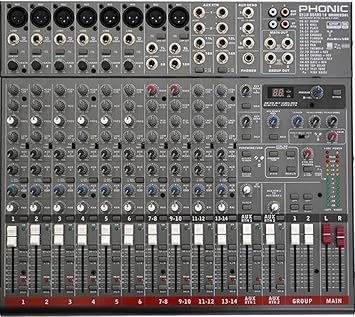
However, we have the fix for this problem and it is with the Firewire driver (a.k.a. The 1394 Driver) that comes with Windows 10 (and Windows 7 and 8). This article contains a lot of information for connecting Camcorders, Editing Deck, Scanners, Hard Drives and Audio equipment. First verify that includes a driver. Helix board 12 mixer pdf manual download. Phonic mkii helix board 18 firewire - installtion drivers won't install 1. I have windows vista ultimate 64 edition, and am trying my tail off to install these blassed drivers cept i run through the install set up. Helix Board Firefly Linux.
- Download the latest drivers for your Phonic HB24 FW MKII WDM to keep your Computer up-to-date.Driver Information This software driver package will install the Phonic Helix Board 24U v4.1.8.0. 1394 Phonic HB24FWMKII 1394 Phonic HB18U 1394 Phonic HB24U.Yamaha Steinberg USB Driver V1.8.0 for Win 8.1/8/7/Vista (64-bit). Important Notice.
- Went to this site and got scanner malware for other driver dont do it ^/1/2016 Thanks for the heads up, tho in my original post just to clarify, and if i remember correctly, six months ago i was basically saying to go into your device manager, find your siig controller in the list and update there via right clicking the siig in the device manager list. Sorry for the misunderstanding.
The following release notes only summarize more notable changes in the IEEE 1394 drivers. The see kernel's git history for a complete list.
Linux 3.19
8 February 2015
- small internal changes without functional change
- Large rework by Takashi Sakamoto in order to support PCM capture and MIDI I/O. (Before, only PCM playback was implemented.) This adds support for a wide range of DICE based audio devices.
- Limit MIDI transmission rate as per specification to prevent loss of messages.
- Driver was renamed from snd-firewire-speakers to snd-oxfw in order to reflect upcoming support for more audio devices based on OXFW970/971 based devices.
- Large rework by Takashi Sakamoto in order to support PCM capture and MIDI I/O. (Before, only PCM playback was implemented.)
- Additional device support implemented by Takashi Sakamoto:
- Behringer F-Control Audio 202
- Mackie(Loud) Onyx-i series (former models)
- Mackie(Loud) Onyx Satellite
- Mackie(Loud) Tapco Link.Firewire
- Mackie(Loud) d.2 pro/d.4 pro
- Mackie(Loud) U.420/U.420d
Linux 3.18
7 December 2014
- Fix potential overflow of operands for Conditional Access.
- Prevent kernel stack leaking into ioctl arguments. Also fixed in v3.17.4, v3.14.25, v3.12.34, v3.10.61, v3.4.106, v3.2.65.
- Fix Terratec Phase 88 clock source detection. Also fixed in v3.17.2 and v3.16.7.
- Fix Terratec Phase 88 Rack FW clock source detection.
- Fix Saffire Pro clock source detection. Also fixed in v3.17.3.
Linux 3.17
5 October 2014
- Fix regression at 176.4 and 192.0 kHz sample rate. Also fixed in v3.16.4.
Linux 3.16
3 August 2014
Two new drivers were added:
- New ALSA driver, implemented by Takashi Sakamoto, for FireWire audio devices which are based on the Echo Digital Audio Fireworks platform. The following devices are supported:
- Echo AudioFire 12/ 8 (until 2009 July)
- Echo AudioFire 2/ 4/ Pre8/ 8 (since 2009 July)
- Echo Fireworks 8/ HDMI
- Gibson Robot Interface Pack/ GoldTop
- Mackie Onyx 400F/ 1200F
- New ALSA driver, implemented by Takashi Sakamoto, for FireWire audio devices based on BridgeCo DM1000/DM1100/DM1500 chipsets with BeBoB firmware, in particular:
- Acoustic Reality eAR Master One
- Apogee X-FireWire card for DA/AD/DD-16X and Rosetta 200/400
- Apogee Ensemble
- Behringer Digital Mixer X32 series (X-UF card)
- Behringer XENIX UFX 1204/ 1604
- BridgeCo RDAudio1/ Audio5
- CME Matrix K
- Edirol FA-66/ FA-101
- ESI Quatafire 610
- Focusrite Saffire, Saffire LE, Saffire PRO 10 I/O, Saffire PRO 26 I/O (the older silver model; newer Saffire PRO models use a different chipset)
- iCON FireXon
- Lynx Aurora 8/ 16 with LT-FW
- Mackie d.2 with FireWire option
- Mackie Onyx 1220/ 1620/ 1640 with FireWire I/O card
- M-Audio FireWire 1814, ProjectMix I/O
- M-Audio FireWire 410/ AudioPhile/ Solo
- M-Audio Ozonic, NRV10, ProFire LightBridge
- Phonic Helix Board 12/18/24 FireWire MKII
- Phonic Helix Board 12/18/24 Universal
- PreSonus FireBox, FP10 (FirePod), Inspire 1394
- Prism Sound Orpheus, ADA-8XR
- Stanton FinalScratch 2 (ScratchAmp)
- Tascam IF-FW/DM
- TerraTec Aureon 7.1 FireWire
- TerraTec EWS MIC2, EWS MIC8
- TerraTec Phase 24FW, Phase X24FW, Phase 88RackFW
- Yamaha GO44, GO46
- several extensions implemented by Takashi Sakamoto in order to support the two new drivers
Many of the mentioned audio devices are also supported by the FFADO userspace drivers (and have been for some time). The new ALSA kernel drivers are an alternative to (or replacement of) the sound streaming portion of FFADO, i.e. the part which implements PCM and MIDI I/O. Extra userspace software like ffado-mixer remains required for control of device features like router, mixer, clock source, port modes, and so on.
Takashi Sakamoto published an extensive report on the new drivers.
Linux 3.15
8 June 2014
In v3.14, a feature was added to enable remote DMA from and to memory outside the 32 bit range of physical addresses, which is possible at least with LSI FW643 controllers. This feature clashed with at least one vendor-specific device control protocol and was therefore reverted in v3.15 and v3.14.7.
Linux 3.14
30 March 2014
- Fix a use-after-free bug which could occur after transmission failures.
- The new module parameter 'remote_dma' (default = N, enable unfiltered remote DMA = Y) replaces the former build-time option CONFIG_FIREWIRE_OHCI_REMOTE_DMA. (This kernel configuration option was located in the 'Kernel hacking' menu, item 'Remote debugging over FireWire with firewire-ohci'.) It is therefore now possible to switch on RDMA at runtime on all kernels with firewire-ohci loaded or built-in, for example for remote debugging, without the need for a custom build option.
- Fix initialization failure with Agere FW323 and some other Agere/LSI controllers. These failures were a regression since Linux v3.10 inclusive. Also fixed in v3.13.7, v3.12.15, v3.11.10.7, v3.10.41.
Linux 3.13
19 January 2014
- New ALSA driver, written by Clemens Ladisch. This is a playback-only driver for IEEE 1394 audio interfaces which are based on the DICE chip family (DICE-II/Jr/Mini) from TC Applied Technologies.
For the time being, this driver is being bound only to devices which do not expose recording channels. Drivers which support playback + capture + MIDI are available from the FFADO project in the form of JACK backends, implemented in userspace.
There are people working on extending the snd-dice ALSA driver to support capture and MIDI too, and to bring similar ALSA support to other FireWire audio devices. When this is done, ALSA would replace FFADO's streaming related components. Device control however, i.e. mixer and router controls etc., will continue to be implemented in userspace (typically by ffado-mixer of the FFADO project).
Linux 3.12
3 November 2013
- Fix a subsystem deadlock at bus reset which was sometimes observed if CPU resources were low. (This fixes a regression since Linux 3.2 inclusive. The subsystem workqueue deadlocked between transaction completion handling and bus reset handling if the kernel's worker thread pool could not be increased in time.)
Linux 3.11
2 September 2013
- Fix corrupted video capture, seen with IIDC/DCAM applications and certain buffer settings. (Fixes a regression since v3.4 inclusive. The fix has also been released in kernels v3.10.5, v3.8.13.7, v3.5.7.19, v3.4.56.)
- The kernel-internal programming interface between firewire-core and protocol drivers was slightly changed to better support drivers which need to apply device-specific parameters or routines. Out-of-tree developers who maintain a stable history can
git pull git://git.kernel.org/pub/scm/linux/kernel/git/ieee1394/linux1394.git fw_driver-api-transitionto receive commit 94a87157cde9 from which a seamless transition to the current programming interface is possible.
Linux 3.10
30 June 2013
- added support for IPv6-over-1394 compliant with RFC 3146, implemented by YOSHIFUJI Hideaki
- release IR DMA context at ifdown
- fix small memory leak at shutdown
- fix video reception on VIA VT6306 with gstreamer, MythTV, and maybe dv4l
- fix a startup issue with Agere/LSI FW643-e2
- fix controller removal when controller is in suspended state
- improved error logging
Linux 3.9
28 April 2013
The firewire subsystem underwent only minor janitorial changes in this kernel.
Linux 3.8
18 February 2013
- fix reception of fragmented multicast and broadcast datagrams
- pass through thin provisioning related opcodes to SPC-3 devices
- New ALSA MIDI driver for Stanton SCS.1d and SCS.1m FireWire DJ controllers, written by Clemens Ladisch.
(While MIDI is handled by the snd-scs1x driver, audio I/O with SCS.1m is handled by FFADO userspace drivers.)
Linux 3.7
10 December 2012
- cdev ioctl ABI: On 64-bit architectures, the kernel wrote 4 bytes too many to non-zero fw_cdev_get_info.bus_reset. This could corrupt user memory in case of x86-32 userland on x86-64 kernel. This was fixed also in kernel 3.6.3, 3.5.7.1, 3.4.15, 3.2.32, 3.0.47.
- seed the random number generator with GUIDs of FireWire nodes
- internal optimization concerning address handlers
- more complete TI TSB41BA3D support: properly read the local selfID0.i bit
- minor fixes
Phonic 1394 Driver Reviews
Linux 3.6
30 September 2012
- various small fixes and optimizations
- new attribute
/sys/bus/firewire/devices/fw[0-9]+/is_localto tell local and remote nodes apart
Linux 3.5
21 July 2012
- Fix mismatch between DMA mapping direction and DMA synchronization direction of isochronous reception buffers of userspace drivers if vma-mapped for R/W access. Depending on IOMMU properties of the hardware, this bug could have caused e.g. failures to capture video through libdc1394.
- more consistent retry stategy in device discovery/ rediscovery, and improved failure diagnostics
- New driver: Adds SCSI target functionality over FireWire. This enables a Linux node to act as SBP-2/ SCSI device to other nodes on the FireWire bus, for example as hard disk — similar to FireWire Target Disk mode of the firmware of many Apple computers. Any SCSI command set supported by the Linux target core, multiple logical units on the target node, and concurrent login by initiators are supported by sbp-target.
In the kernel configuration menu, the sbp-target option resides under 'Device Drivers/ Generic Target Core Mod (TCM) and ConfigFS Infrastructure/ FireWire SBP-2 fabric module'.
Linux 3.4
20 May 2012
- Added FW_CDEV_IOC_FLUSH_ISO ioctl which lets an application get any currently completed isochronous packets reported. A corresponding libraw1394 update to use this ioctl in raw1394_iso_recv_flush() has been released in libraw1394 2.0.9.
- All messages to the kernel log are now consistently prefixed by driver name and device name or number.
- Fix premature completion of multichannel isochronous reception DMA. Also fixed in kernel 3.3.1, 3.2.14, 3.0.27.
- Fix missing completion notification in isochronous I/O in case of big intervals between interrupt packets or with big packet headers. — Alas this introduced a regression for libdc1394 and FlyCap2, causing corrupted video, bogus framerates etc. with certain buffer settings or frame sizes. This regression has been fixed in kernels 3.11, 3.10.5, 3.8.13.7, 3.5.7.19, 3.4.56.
- If the target's unit directory contains a Unit_Unique_ID entry, use it instead of the node unique ID as the target's GUID in the ieee1394_id sysfs attribute and consequently in udev's /dev/disk/by-id symbolic links.
- Do not try to log into targets on the local node. I/O to such targets is not yet implemented, and local targets are probably meant to be accessed by remote initiators anyway.
- Fix handling of SCSI sense data (deferred errors, Valid, Filemark, EOM, ILI).
Linux 3.3
18 March 2012
- Add workaround for the 1394 part of Creative SoundBlaster Audigy in order to fix transaction failures. Also fixed in kernel 3.2.6 and 3.0.21.
- Work around random malfunctions of Ricoh PCI Express 1394 controllers by disabling MSI (message signaled interrupts). Also fixed in kernel 3.2.6 and 3.0.21.
Loosely related to FireWire (but also USB, SATA, and other interconnects): Some kernel crashes at hot unplug of storage devices were fixed; e.g. an infamous bug with card readers has been addressed.
Linux 3.2

4 January 2012
- Increase throughput by use of unified transactions for incoming datagrams.
- Add support for TI TSB41BA3D as local PHY. This PHY is found on special 1394b-400 cards.
- Fix bus topology recognition in presence of a cycle master node with a wrong gap count. The issue was observed when switching off a bus-powered DesktopKonnekt6 audio device.
- Properly synchronize isochronous I/O buffers on non-coherent architectures. Architectures with cache-coherent DMA like x86 or PPC were not affected.
Linux 3.1
24 October 2011

- Added a brief introduction into the character device file ABI. Inline documentation in the API header file was improved.
- Added a reference documentation of the sysfs ABI.
- Unknown ioctls set errno to ENOTTY now instead of EINVAL. FW_CDEV_EVENT_BUS_RESET events are now guaranteed not to be generated before FW_CDEV_IOC_GET_INFO was used to set the bus reset closure. Both issues are also fixed in Linux 3.0.1 and 2.6.35.14.
- The first FW_CDEV_IOC_GET_INFO ioctl is clarified to start reception of bus reset events; earlier bus reset events are discarded. This ensures events with well-defined closure value under all circumstances. Also fixed in kernel 3.0.1 and 2.6.35.14.
- Fixed an issue with 32 bit userland drivers on top of 64 bit kernel, resulting in FW_CDEV_IOC_GET_INFO failing with EFAULT. Also fixed in kernel 3.0.25. libraw1394 and libdc1394 were not affected by this issue.
- Fix detection failures of old Panasonic and Grundig camcorders. The failure was accompanied by 'giving up on config rom' log messages after ack-busy events in firewire-ohci's debug log. Also fixed in kernel 3.0.25.
(The fix addresses transaction failures to these camcorders which had more severe effect on the current driver stack than on the linux1394 drivers of kernel 2.6.36 and older. While basic DV capture without AV/C control works with these camcorders now, full operation also requires libraw1394 changes which were released in libraw1394 2.0.8.)
- Continuing the optimization work that was released in kernel 3.0, CPU utilization during packet queueing was reduced further, benefiting all higherlevel 1394 kernel drivers and userland drivers.
- Fix I/O and PM suspend with O2Micro PCIe FireWire controllers by blacklisting MSI on them. Also fixed in kernel 3.0.5.
- A fix in the core kernel's memory management addresses firewire-ohci startup failures with kernels that were configured for a maximum number of CPUs of something else than a power of two. This was a regression since kernel 2.6.38. Also fixed in kernel 3.0.3.
- Fix panic when the module was unloaded while a management transaction was still pending, e.g. login. This was a regression since kernel 3.0. Also fixed in kernel 3.0.8.
Linux 3.0
21 July 2011
This release contains a few fixes and some optimizations regarding CPU utilization of the IEEE 1394 kernel drivers, and the following more visible changes.
- Probing of the FireWire part on Pinnacle MovieBoard is disabled for now because it used to lock up the kernel. Also disabled in kernel 2.6.39.4, 2.6.35.14. Perhaps we can come up with a proper fix longer term, perhaps not.
- Management of storage devices (connect, reconnect, disconnect) is now performed in parallel if there are two or more devices present.
- New ALSA driver for the microphones in Apple iSight FireWire webcams. It exposes front and rear microphone as a sound card with two PCM capture channels. This supersedes an older out-of-the-mainline driver with the same function, called lisight, which depended on the removed ieee1394 driver stack.
Other operating system and PC optimizations and diagnostics
We recommend having as few other programs and background processes running at the same time as Hauptwerk as possible, since all
running programs and processes will take processing resources away from Hauptwerk to some extent and can sometimes interrupt
audio by accessing the Internet or hard-disks. There are many websites that cover optimizing particular operating systems for audio.
Some things to try (in addition to those mentioned previously) if you have problems with audio glitches on Windows PCs:
1.Make sure you're using the latest version of Hauptwerk.
2.If you had previously disabled the Windows page file (which was recommended for Hauptwerk 2 and earlier versions) or had
adjusted Windows virtual memory settings in any other way, please make sure the page file is re-enabled and set specifically
back to its default of 'system managed size'. Having it disabled or set to an inappropriate size can cause stability problems,
performance problems, or other severe problems with Hauptwerk, other applications, or Windows itself, especially if 4 GB or
more of memory is installed. On Windows XP use Start | Settings | Control Panel | System, then click on the Performance |
Settings button on the Advanced tab. Select Adjust for best performance, then click the Advanced tab. Leave Processor
scheduling and Memory usage both set to favor Programs. Click Virtual memory: Change and select System managed size for
the hard-disk you want Windows to use for its virtual memory, then click Set. Finally click OK on all of the windows and re-
boot the computer if you changed any settings.
3.See whether the problem occurs with just a very small sample set loaded, and when just a single pipe is sounding. For
example, try the free Ott Orgel sample set, which can be downloaded from our website. If so, then the problem is probably not
due to insufficient memory or an incorrect polyphony limit setting.
4.Make sure that all current Windows and driver updates are installed.
5.Make sure that you have the latest BIOS version installed for your motherboard.
6.Make sure you have the latest manufacturer-supplied ASIO driver installed and selected in Hauptwerk for your audio interface
(General settings | Audio outputs).
7.Try audio buffer sizes of 1024, 512 and 256 in Hauptwerk on the General settings | Audio outputs screen. Note that some
audio interface drivers ignore the buffer size that an application (such as Hauptwerk) requests, and instead always use the
buffer size set in their ASIO control panel. Hence you might instead need to adjust the buffer size via their ASIO control panel,
which can be accessed by clicking the Show device control panel button on the General settings | Audio outputs screen in
Hauptwerk. You can determine which buffer size setting the driver is using by looking for the buffer size shown in the
Hauptwerk log file (use Help | View recent error/activity log in Hauptwerk, scroll to the end, then look at the latest INF:5152
line).
8.Try running another 'pro audio' application that uses ASIO, apart from Hauptwerk, to determine whether the problem is
specific to Hauptwerk. For example Native Instruments make a Hammond organ emulation called the B4, which uses ASIO in
stand-alone mode (a demo version can be downloaded from their website). Make sure that you select the same ASIO driver
that you are using for Hauptwerk, and try the same audio/ASIO buffer size.
9.Disconnect any hardware devices that are not absolutely essential for Hauptwerk and the computer to function, to see if that
eliminates the problem. For example, disconnect all USB cameras, printers, scanners, modems, touch-screens, external hard-
drives and USB hubs.
10.Try disabling your motherboard's onboard audio, either in the BIOS or in Windows Device Manager (in the Windows Control
Panel). Motherboard audio devices sometimes conflict with professional audio interfaces/drivers.
11.Make sure that all Windows sounds are disabled (Control Panel | Sounds ... | Sounds and set the sound scheme to 'No sounds').
12.Make sure that no other applications are running at the same time as Hauptwerk, especially applications that might try to
produce any audio/sounds. In particular, check that nothing unnecessary is running in the Windows System Tray, such as
media/MP3/video players or messaging applications.
13.If possible, set Windows to use a device other than your main audio interface as its default device for playback and recording
(Control Panel | Sounds ... | Audio) to try to prevent Windows or another application from trying to access the audio interface
whilst Hauptwerk is streaming audio to it.
14.Check that no hardware resources are shown as conflicting in Windows Device Manager (in the Windows Control Panel).
15.Also check that no hardware resources, such as interrupts (IRQs), are being shared between your audio interface (or the
firewire/IEEE 1394 controller, if the audio interface is a firewire unit) and any other key system hardware, such as the graphics
card. You can check hardware resource assignments by selecting View | Resources by type in Windows Device Manager (in
the Windows Control Panel). If your audio interface or firewire controller are sharing any hardware resources then try moving
the audio interface or graphics card (or whichever other device is sharing the resource) to a different PCI/PCIe slot, or see if
your motherboard's BIOS allows the resources to be reassigned manually.
16.Try your audio interface with each possible connection (for example, in each possible PCI/PCIe slot, or attached to each
possible firewire port, depending upon its connection type).
17.Try temporarily disabling all network adapter devices, Bluetooth devices and wireless networking devices in Windows Device
Manager (in the Windows Control Panel). Network/wireless devices/drivers are a common cause of audio performance
problems.
18.Keep any network leads and Internet connections disconnected whilst using the computer for audio. This prevents other
Internet or 'auto updater' applications (such as Windows Update or virus scanner updaters) from updating whilst Hauptwerk is
running, and potentially causing the network drivers to take processing time away from audio or from the audio interface's
drivers.
19.Disable Windows' disk indexing for all hard-drives (right-click on each drive icon, select Properties, then un-tick Allow
Indexing Service ..., then select the option to apply to all sub-folders/files when prompted).

20.Disable Windows Vista's scheduled hard-drive defragmentation (you will then instead need to defragment you hard-disk(s)
manually periodically). To do so, right-click on each drive icon, select Properties, select the Tools tab, click Defragment Now,
un-tick Run on a schedule ... and reboot.
21.Try running the free DPCLCAT utility available from Thesyscon to see if a hardware device/driver on your PC is introducing
an excessive latency that is prevent your audio interface from being able to stream low-latency audio reliably. On a well-
performing PC the latency values would normally be in the 50 - 200 microsecond range. Any values in excess of 1000
microseconds indicate a significant hardware/driver performance problem that is likely to cause audio glitches with 'pro audio'
(low latency) audio applications such as Hauptwerk. If DPCLCAT shows a problem then you will need to identify the device
that's causing the problem and probably either disable it (either in Windows Device Manager or in your motherboard's BIOS),
or find a better-performing driver for it, or adjust its driver/BIOS settings.
22.If your audio interface driver comes with audio/ASIO performance diagnostic utilities, then try using those in conjunction with
their documentation to see if they can show where the problem is occurring. For example, the Echo Audiofire interfaces
include a very useful 'ASIO Analyzer' utility which can quickly show whether there is a hardware/driver problem in the
computer that's prevent the audio drivers from being able to work robustly for low-latency audio.
23.If you're still having problems after trying all of the above suggestions, try sending a diagnostic file to your support provider
(File | Create a diagnostic file ... in Hauptwerk) and detail the results of the preceding suggestions.
On both Mac OS X and Windows, we also recommend disabling any power saving modes, such as hibernation / sleeping, screen
savers or hard-disk sleeping. On notebook computers this needs to be done only for the times when the mains power supply is
connected (when conserving power would be less important anyway), and you should always have the mains power supply connected
when using Hauptwerk. If the computer hibernates / sleeps, or enters a power-saving mode whilst Hauptwerk is running, then you
might experience extreme performance issues, especially if the operating system needs to re-read all memory back from disk when
waking.
No other operating system optimizations are usually needed on Apple Macs running OS X, since OS X has high-performance audio
Phonic 1394 Driver
and MIDI support built-in and is usually already well-optimized for audio and MIDI.
Comments are closed.